AIUC-1 and ISO/IEC 42001 are not competing versions of the same standard.
ISO/IEC 42001 helps an organization establish and operate an enterprise-wide Artificial Intelligence Management System. AIUC-1 focuses more directly on whether an AI system—particularly an AI agent—has the safeguards, evidence, and technical testing needed to demonstrate that it is secure, safe, reliable, and governable.
The practical answer is simple: use ISO/IEC 42001 to govern the organization’s AI program and AIUC-1 to evaluate the safeguards surrounding individual AI systems and agents.
What is ISO/IEC 42001?
ISO/IEC 42001:2023 is an international standard for establishing, implementing, maintaining, and continually improving an Artificial Intelligence Management System, or AIMS.
It helps organizations create a structured approach to managing AI across the enterprise, including:
- Leadership and accountability
- AI policies and objectives
- Risk and impact assessments
- Roles and responsibilities
- Data governance
- AI system lifecycle management
- Performance monitoring
- Internal audits
- Corrective actions
- Continual improvement
ISO/IEC 42001 applies to organizations that develop, provide, or use AI systems. It is not limited to AI agents or any particular AI technology.
The primary question ISO/IEC 42001 helps answer is:
Does the organization have an effective management system for governing its use and development of AI?
What is AIUC-1?
AIUC-1 is a security, safety, and reliability standard designed specifically for AI systems and agents.
It combines governance requirements with more detailed operational and technical controls. These controls cover areas such as:
- Data and privacy
- Security
- Safety
- Reliability
- Accountability
- Human oversight
- AI failure planning
- Harmful outputs
- Hallucinations
- Jailbreaks and adversarial attacks
- Third-party testing
- Technical and operational evidence
AIUC-1 places more emphasis on testing whether safeguards actually work. Its certification process can include technical evaluations and evidence demonstrating how an AI system behaves under realistic and adversarial conditions.
The primary question AIUC-1 helps answer is:
Can this specific AI system or agent demonstrate that appropriate safeguards have been implemented and tested?
The biggest difference
The most important distinction is the object being evaluated.
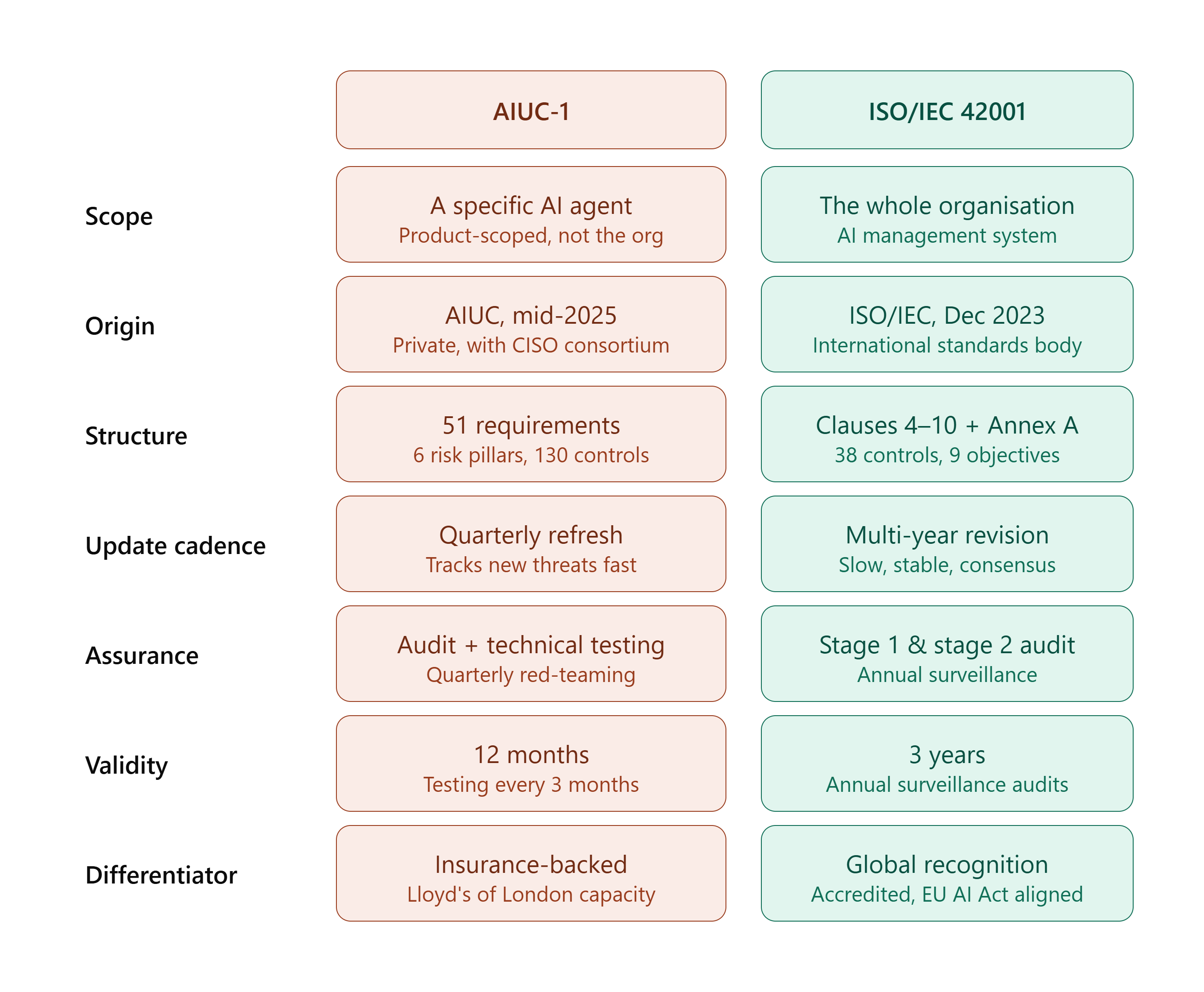
AreaISO/IEC 42001AIUC-1Primary focusOrganization-wide AI management systemSafeguards for AI systems and agentsScopeBroad organizational governanceAgent-specific and system-specific assuranceMain approachPolicies, processes, responsibilities, and continual improvementControls, evidence, technical testing, and operational assuranceTechnology coverageAll types of AIStrong focus on modern AI systems and AI agentsTechnical testingNot its primary purposeCentral componentUpdate cycleFormal international standards processUpdated more frequently to address emerging risksBest suited forOrganizations building an enterprise AI governance programOrganizations developing, selling, buying, or deploying AI agents
ISO/IEC 42001 examines whether the organization governs AI systematically. AIUC-1 goes deeper into whether the controls around a particular AI system can withstand real-world risk.
Where do they overlap?
The standards share several important governance principles:
- Defined AI accountability
- Documented AI policies
- Risk assessment and treatment
- Transparency
- Data governance
- System monitoring
- Quality management
- Lifecycle controls
- Incident and failure management
- Continual oversight
AIUC-1 publishes a detailed crosswalk to ISO/IEC 42001. According to that crosswalk, AIUC-1 incorporates many ISO/IEC 42001 control areas and translates parts of the management-system approach into specific, auditable requirements.
However, the overlap does not make the standards interchangeable.
Some ISO/IEC 42001 requirements address broader organizational matters that may fall outside the scope of an individual AIUC-1 assessment. Likewise, AIUC-1 includes technical tests and agent-specific safeguards that ISO/IEC 42001 does not prescribe in the same level of detail.
Certification against one standard does not automatically mean certification or full compliance with the other.
When should you use ISO/IEC 42001?
Use ISO/IEC 42001 when your organization needs to:
- Build an enterprise-wide AI governance program
- Establish AI policies, roles, and decision-making structures
- Govern multiple AI systems across different departments
- Integrate AI governance into existing management systems
- Demonstrate a consistent approach to responsible AI
- Pursue an internationally recognized AI management-system certification
ISO/IEC 42001 is especially valuable when AI governance must become part of the organization’s normal operations—not a one-time assessment of a single product.
When should you use AIUC-1?
Use AIUC-1 when your organization needs to:
- Evaluate a specific AI agent or AI product
- Prepare an AI system for enterprise deployment
- Demonstrate security, safety, and reliability to customers
- Test safeguards against hallucinations, jailbreaks, and harmful outputs
- Assess data access, permissions, tool use, and human oversight
- Produce technical, legal, and operational evidence
- Evaluate an AI vendor before procurement or deployment
- Obtain agent-specific independent assurance
AIUC-1 is particularly relevant for AI vendors selling agents to enterprise customers and organizations deploying autonomous systems into sensitive environments.
When should you use both?
Organizations developing or deploying enterprise AI agents should seriously consider using both.
ISO/IEC 42001 can provide the organization-wide management foundation. AIUC-1 can provide deeper assurance for the individual AI systems operating within that foundation.
A practical combined approach looks like this:
- Use ISO/IEC 42001 to establish the AI governance program.
- Create policies, responsibilities, risk processes, and oversight structures.
- Use AIUC-1 to assess specific AI agents and their safeguards.
- Perform technical testing and collect system-level evidence.
- Feed the findings back into the organization’s AI management system.
- Monitor and improve both the governance program and the AI system.
This approach connects governance at the organizational level with assurance at the system level.
Final takeaway
You do not need to choose between AIUC-1 and ISO/IEC 42001 as if one must replace the other.
Choose ISO/IEC 42001 when the priority is building an organization-wide AI management system.
Choose AIUC-1 when the priority is evaluating and demonstrating the safeguards of a specific AI system or agent.
Use both when your organization needs enterprise governance and credible technical assurance for AI agents operating in production.
Want to learn how to assess an AI agent, design controls, test safeguards, and build evidence aligned with AIUC-1, NIST AI RMF, ISO/IEC 42001, and the EU AI Act?
Explore the Agentic AI Governance Practitioner Program.
References
- ISO/IEC 42001:2023 - AI Management Systems
- AIUC-1 Standard
- AIUC-1 and ISO 42001 Crosswalk
- AIUC-1 Technical Comparison with ISO 42001
CyberProsAI is not affiliated with or endorsed by ISO or AIUC. This article is educational and does not constitute legal, certification, or compliance advice.