July 15, 2026
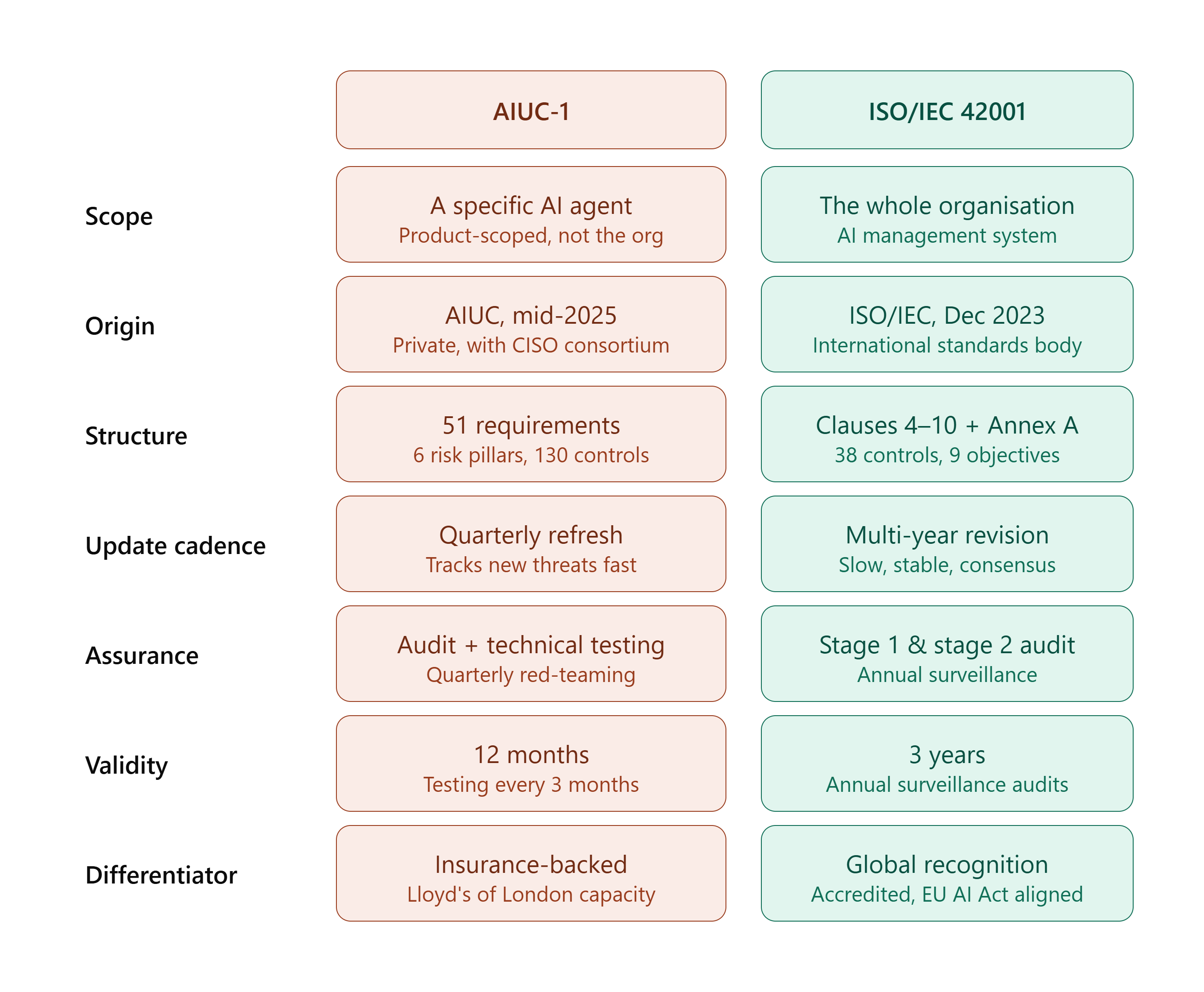
AIUC-1 vs. ISO 42001: Differences, Overlap, and When to Use Each
AIUC-1, ISO 42001, AI Governance, AI Standards, Agentic AI Governance
About CyberProsAI
Get Started
plans
plans
Organizations are deploying AI systems that can access information, use tools, interact with users, make decisions, and initiate actions.
At the same time, many professionals are being asked to govern those systems using policies and review processes designed for traditional software, static models, or human-led workflows.
That gap creates a serious operational problem.
Organizations need people who can connect AI architecture, business context, risk, controls, testing, regulation, evidence, and executive decision-making.
CyberProsAI exists to prepare those people.
Our programs are built around the frameworks regulators and enterprises actually use:


.png)

plans
Get Started
plans
plans
plans
Get Started
plans
plans

Governance must produce evidence
Policies and principles matter, but they are not enough. Organizations need documented scope, risk assessments, controls, tests, ownership, decisions, and monitoring.

Frameworks are inputs not the final product
A framework can guide the work. It cannot replace professional judgment, system-specific analysis, evidence, or accountability.

Responsible AI must be operational
Responsible AI becomes real when it changes how systems are designed, approved, deployed, monitored, and retired.
François B. Arthanas founded CyberProsAI to help professionals and organizations move beyond high-level AI principles and build governance systems that work in practice.
His background spans cybersecurity, audit, governance, technology risk, professional education, and AI governance. He holds the CISSP, CISA, AAIA™, TAISE, CDPSE, and SecX credentials.
Across his career, François has helped professionals translate complex security, risk, compliance, and technology concepts into work they can perform and defend.
His current work focuses on a central enterprise challenge:
How do we govern AI agents that can access data, use tools, interact with systems, make decisions, and create business impact before a human reviews the outcome?
Meet the
Founder


Statement
I built CyberProsAI around one expectation: you should leave every program able to perform the work not simply repeat framework language.
Agentic AI Governance requires professional judgment. It requires people who can investigate a system, identify what matters, challenge weak evidence, design controls, plan meaningful tests, and communicate a defensible decision.
That is the capability we are building.
plans
Get Started
Blogs & Articles
plans
CyberProsAI prepares professionals and organizations to govern enterprise AI agents, manage AI risk, and implement responsible AI programs through practical training, evidence, controls, testing, and monitoring.